



3D Printer Filtration System V1
Regular price $74.99 $89.99 | Save $15.00 (16% off)
Estimated delivery between and .

PRODUCT DETAILS
Clean Air, Better Prints — Advanced 3D Printer Filtration System V1
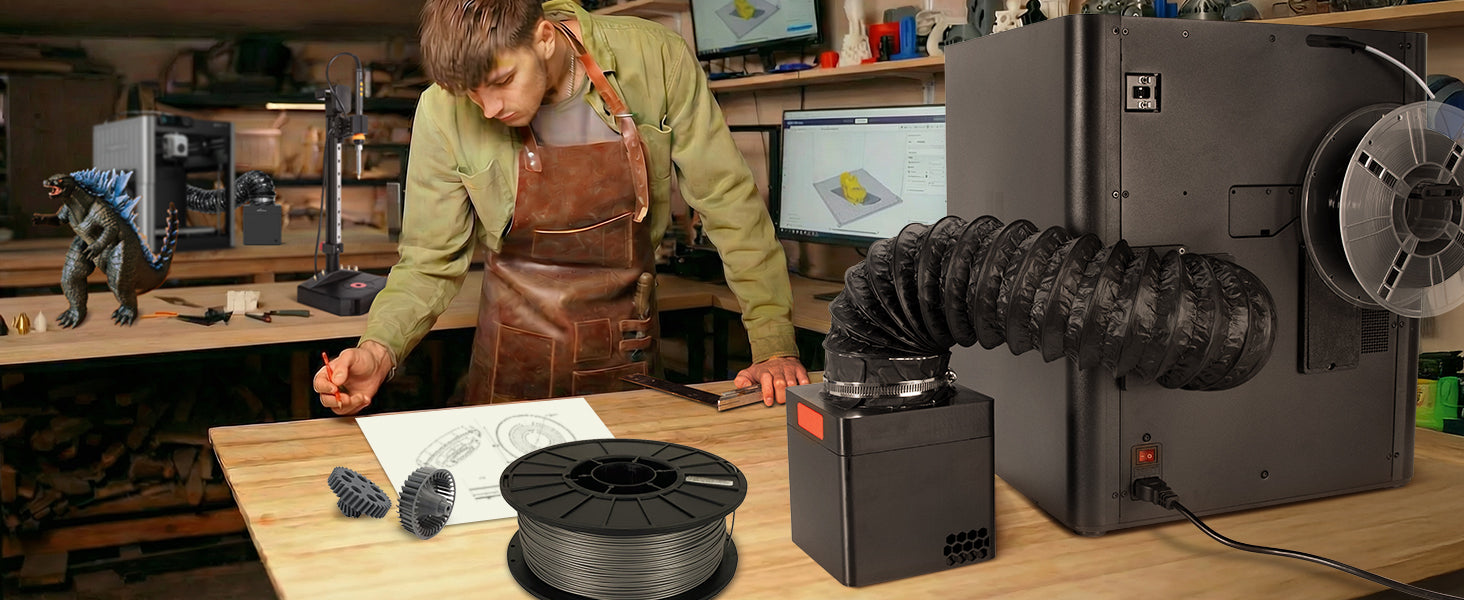
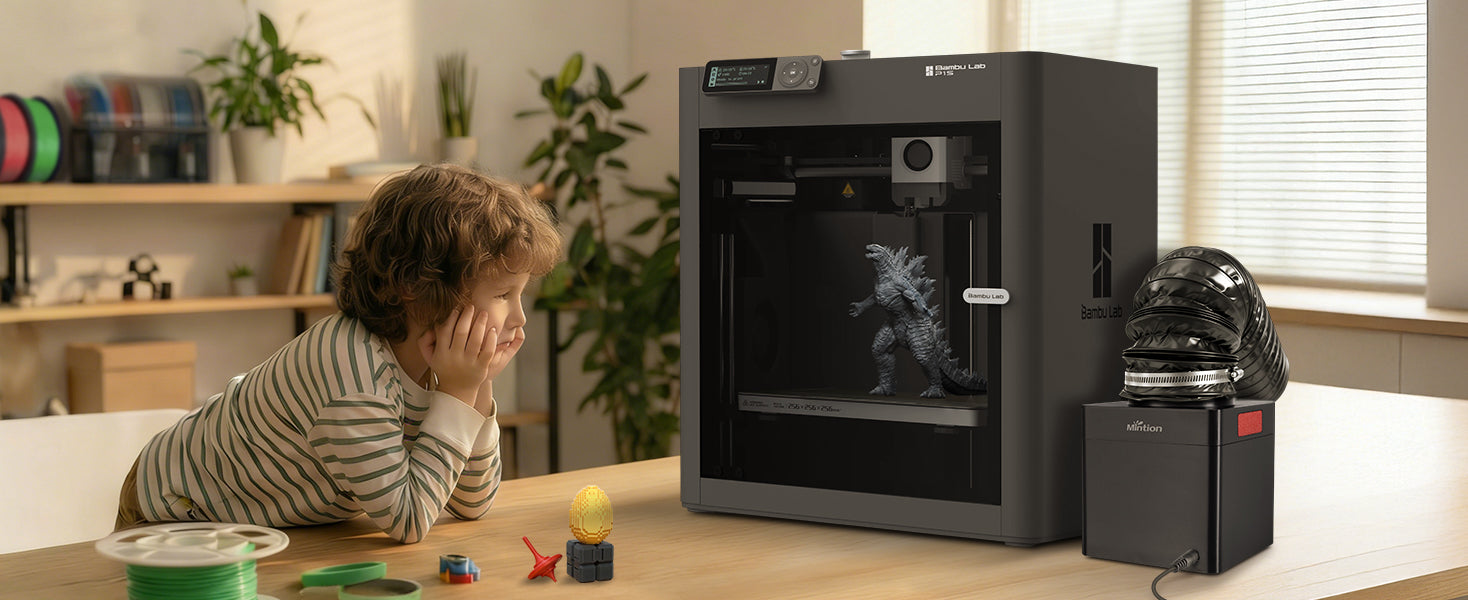
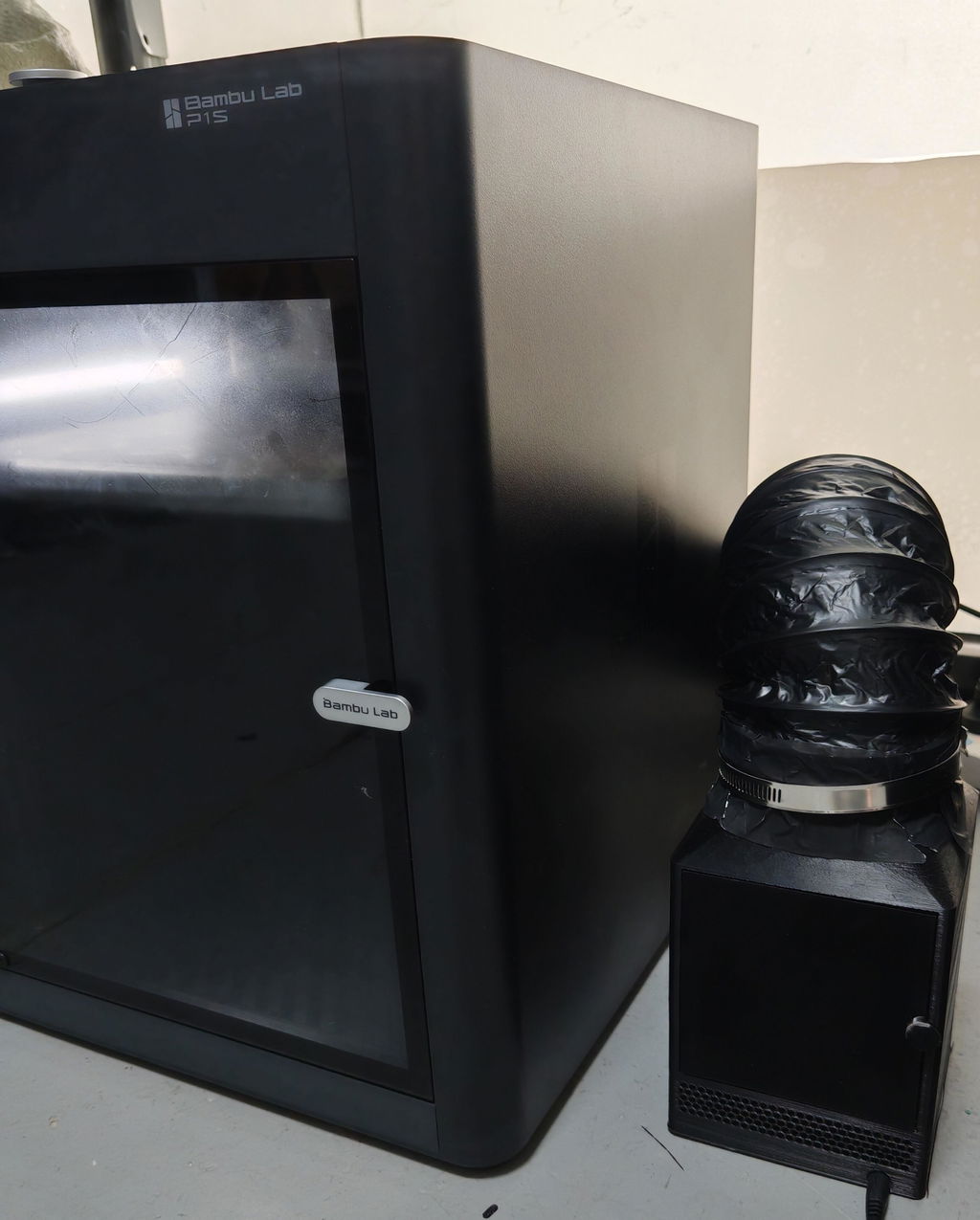
Keep your workspace safe and odor-free with the 3D Printer Filtration System V1, engineered to capture harmful particles and fumes released during 3D printing. Featuring a triple-layer filtration stack and a high-efficiency centrifugal fan, this compact unit supports a wide range of filament types and is designed for both hobbyists and professionals.
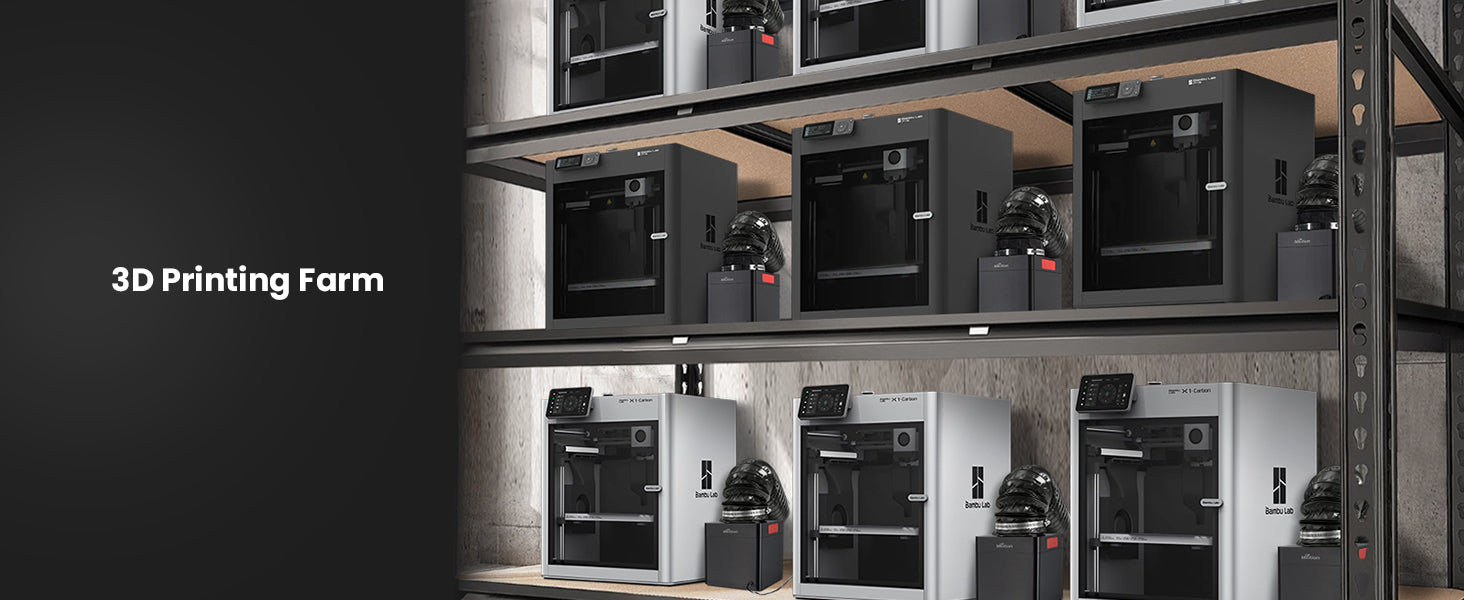
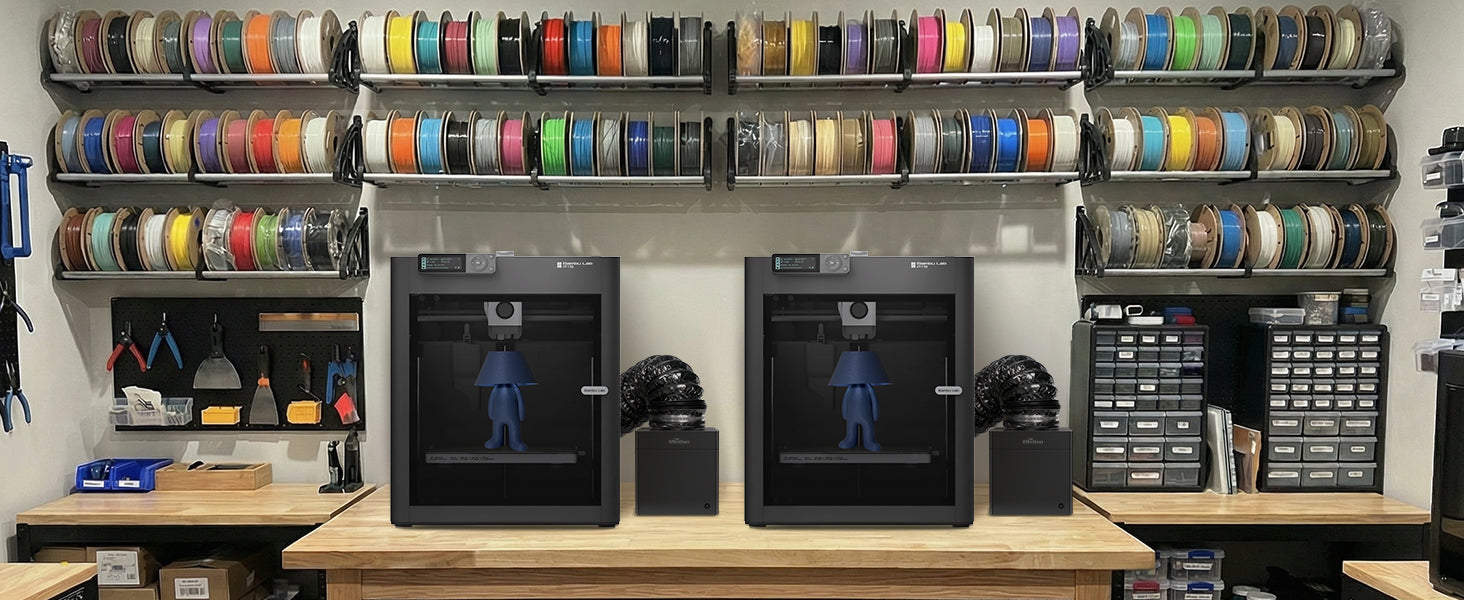
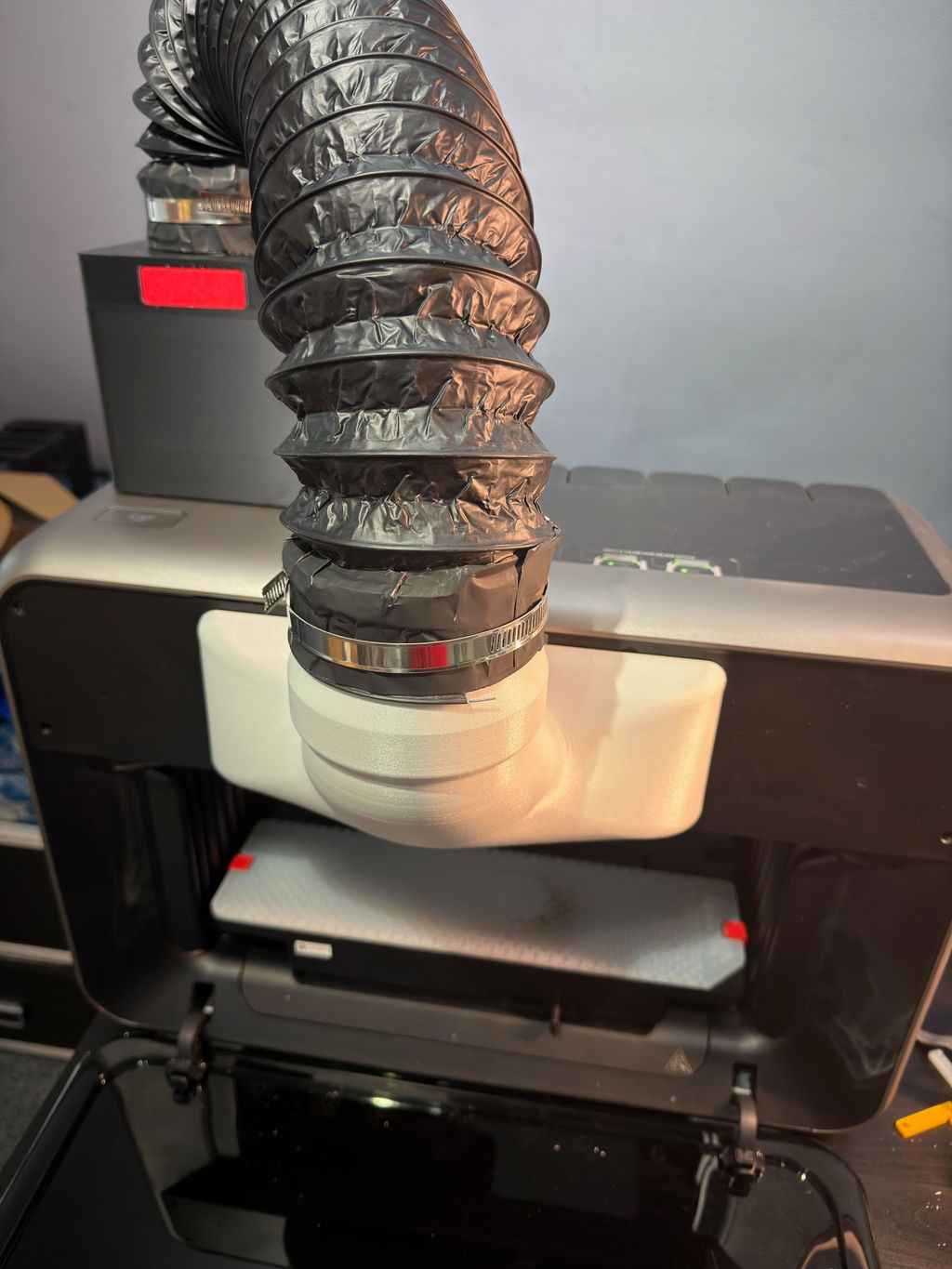
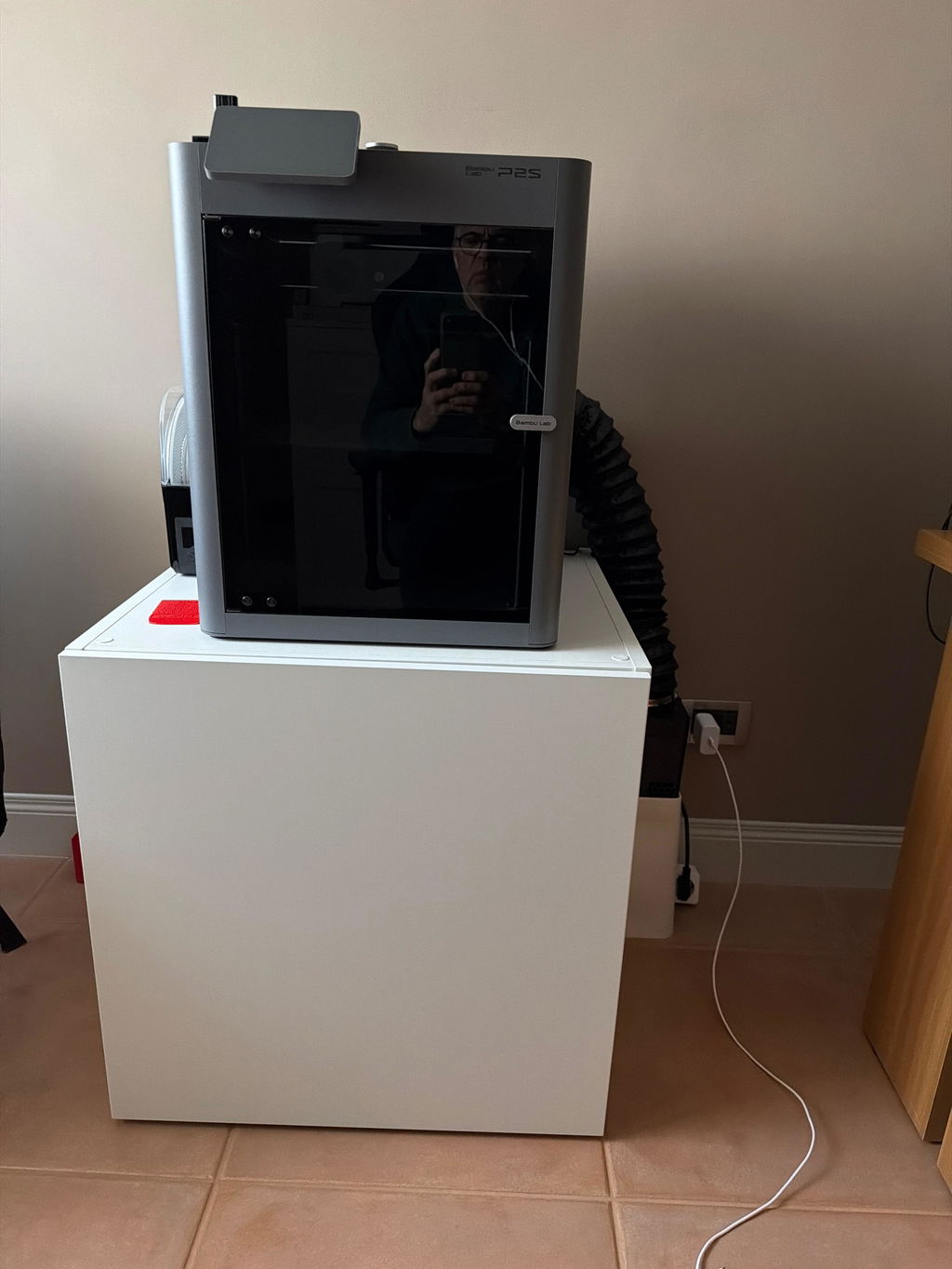
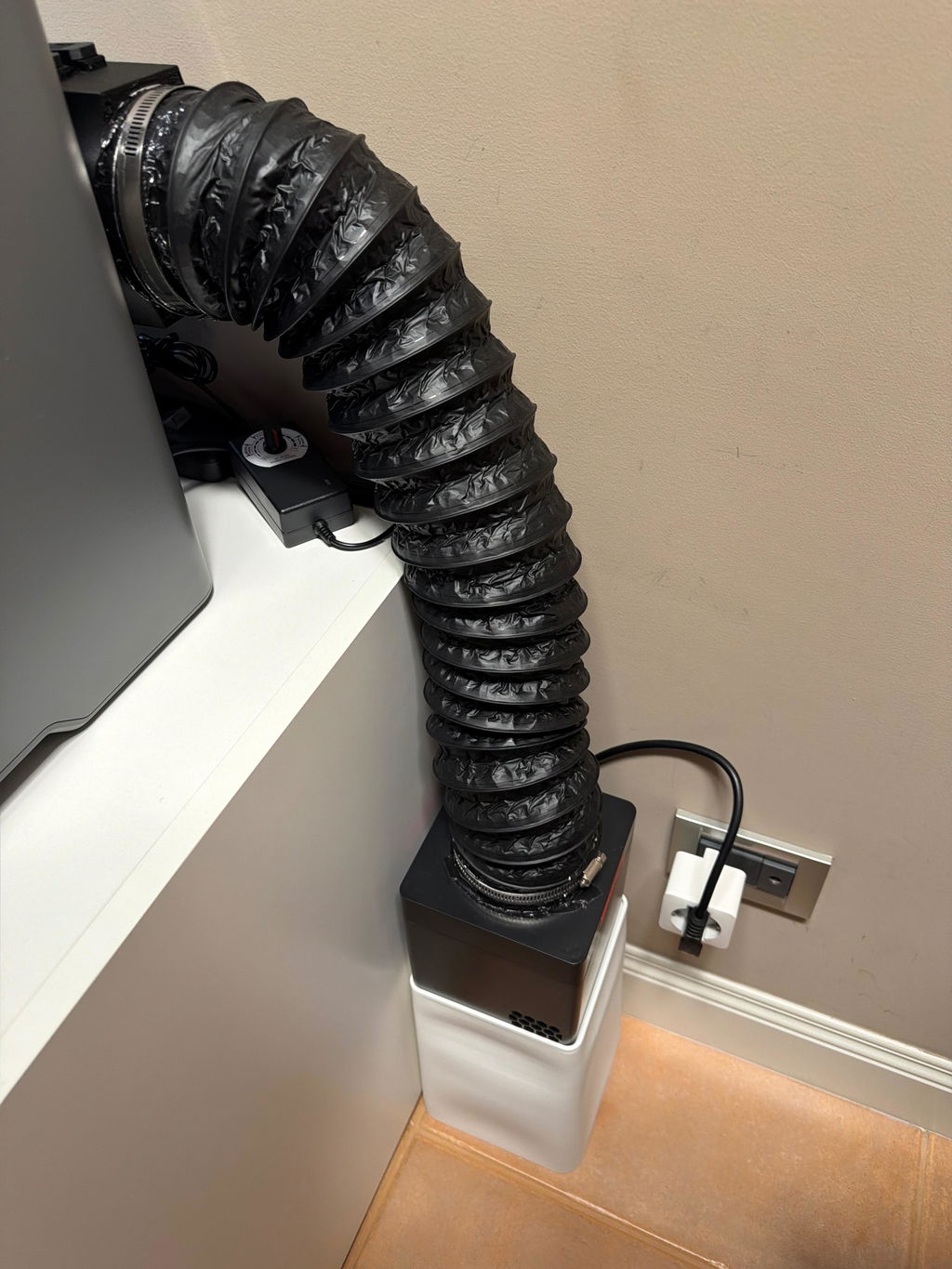
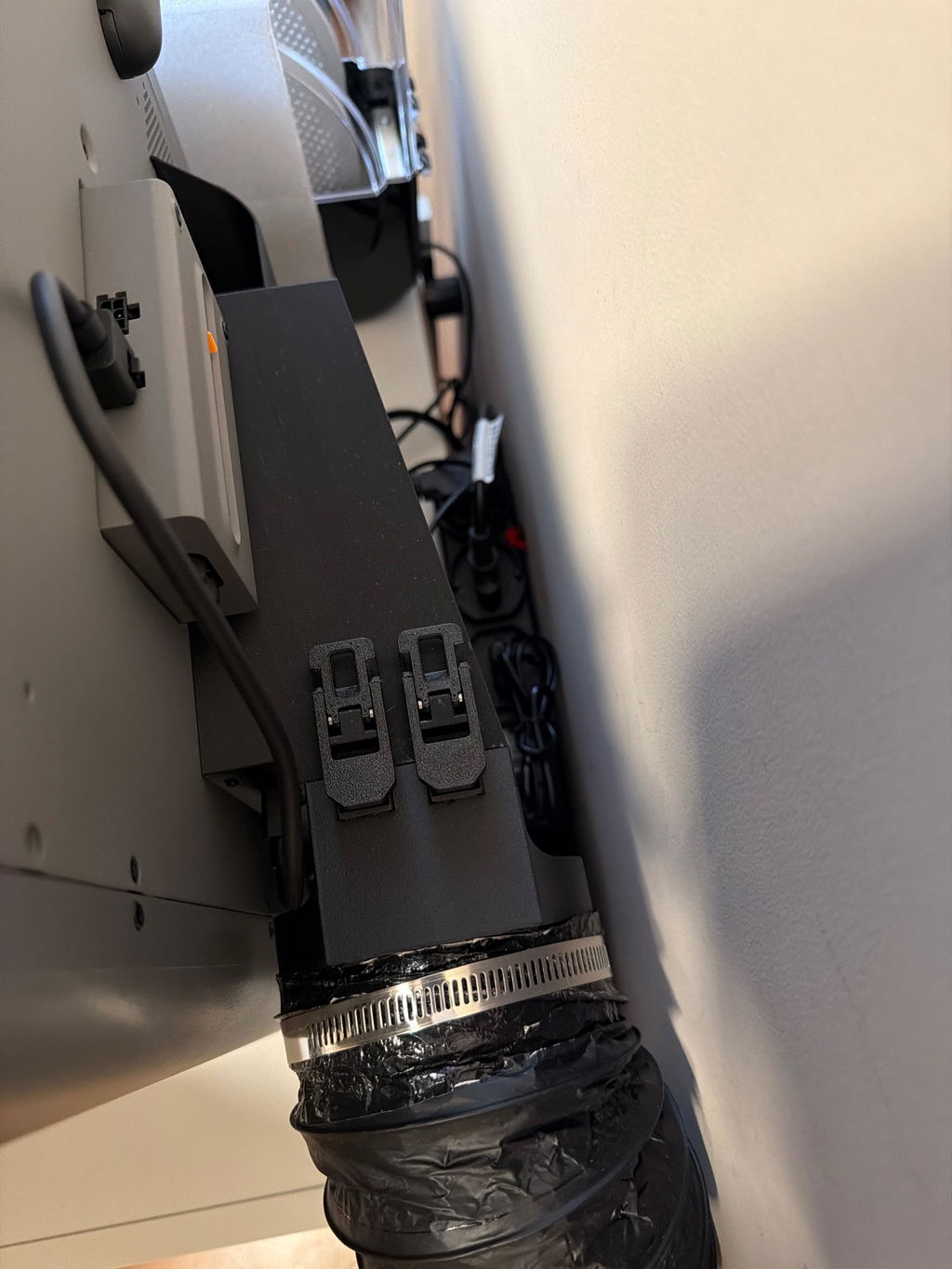
It ships with a default connector for Bambu P1S/X1C and can be extended to H2S/H2D, P2S and other enclosed 3D printers with appropriate adapters. You can reach this article to check the V1 Compatible Connectors List, and some item of Creality, Elegoo, Prusa 3d printers are on the list.
Key Features
🔹 Triple-Layer Filtration for Maximum Protection
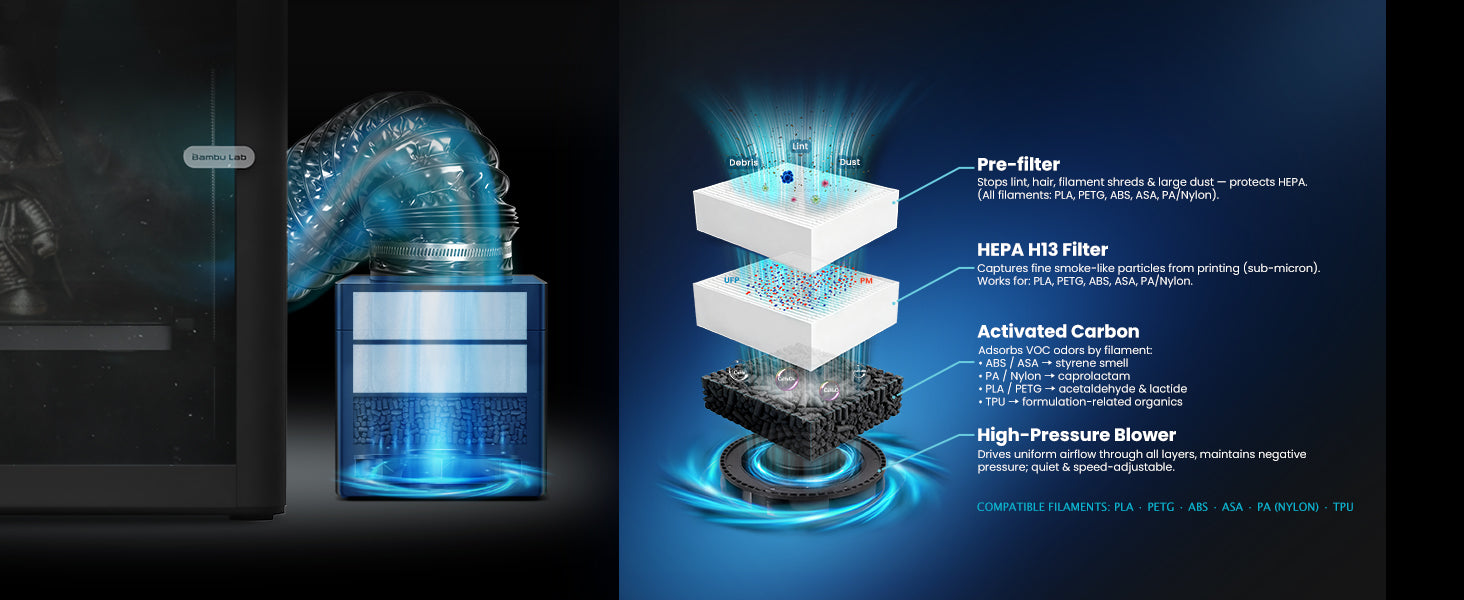
Pre-Filter: Traps large dust and debris, extending the life of downstream filters.
HEPA H13 Filter: Captures ultrafine particles generated when printing PLA, PETG, ABS, ASA, and Nylon.
Activated Carbon Bed: Adsorbs VOCs and chemical fumes such as styrene and caprolactam, helping keep air fresh and clean.
🔹 Optimized for 3D Printing Filaments
PLA / PETG: Targets ultrafine particle emissions.
ABS / ASA: Reduces styrene and other VOC fumes.
Nylon: Mitigates caprolactam and related emissions.
🔹 Efficient Centrifugal Fan Design
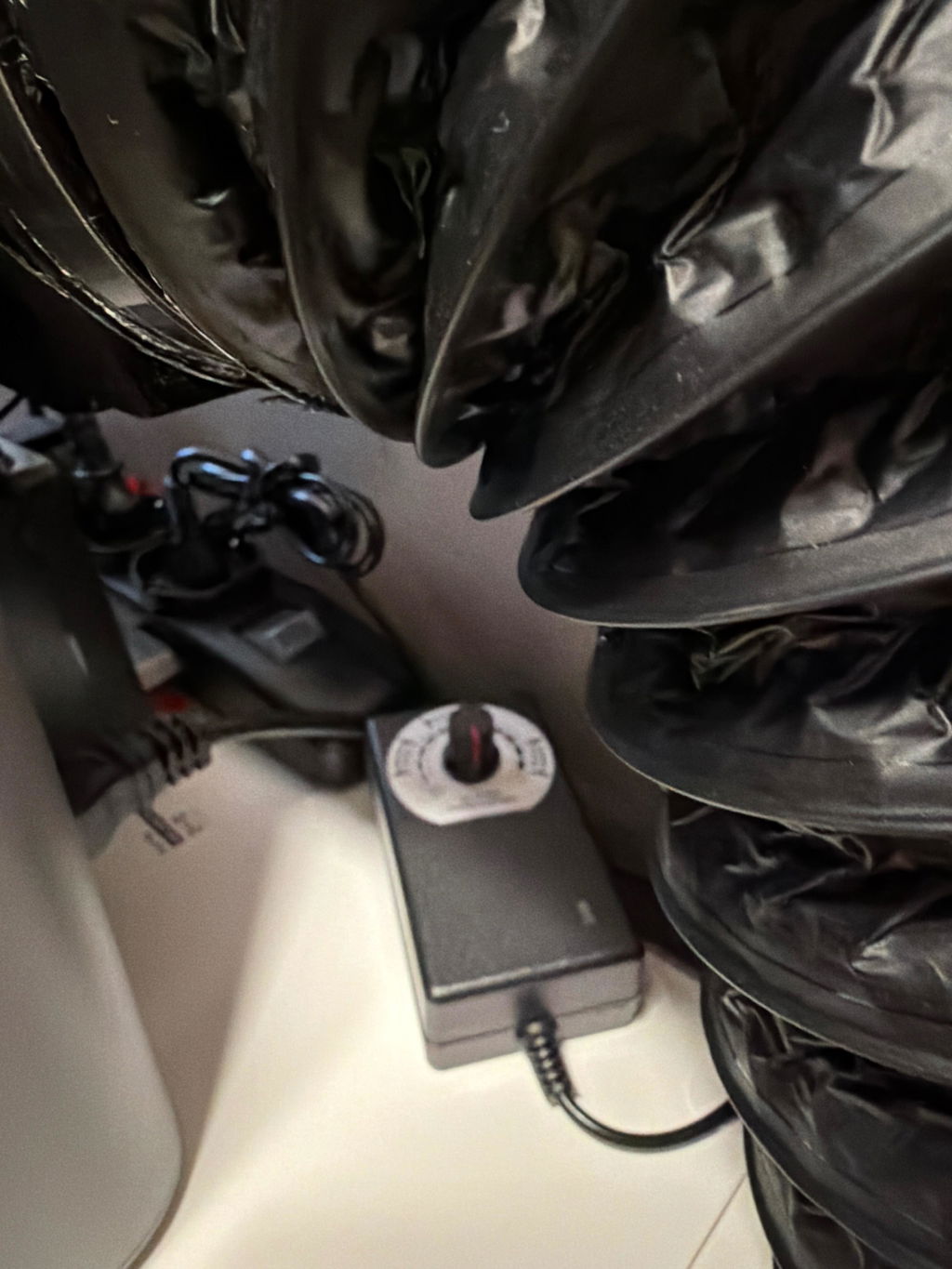
Provides stable pressure and airflow through all filter stages, with air velocity up to 10 m/s at the outlets and volumetric airflow up to 60 m³/h, ensuring consistent purification without impacting print performance.
🔹 Compact & Easy to Use
Lightweight, space-saving design fits beside or inside printer enclosures. Quick-swap filter modules simplify maintenance and support long-term use.
🔹 Safe & Reliable
Improves workspace air quality and helps reduce contamination around the printer—supporting better, more consistent prints and extending component life.
V1 Compatibility Summary
| Printer / Enclosure | Works with V1? | Adapter Needed? | Notes |
| Bambu Lab P1S/X1C | Yes | Included default connector | Recommended |
| Bambu Lab P2S | Yes | Adapter required | Download printable file (4 solutions) |
| Bambu Lab H2D/H2S/H2C | Yes | Adapter required | Download printable file |
| Prusa Enclosure | Yes | Adapter required | Download printable file |
| Creality K1 / K2 | Yes | Adapter required | Download printable file |
| Flashforge 5M Pro | Yes | Adapter required | Download printable file (Need to Modify) |
| Elegoo | Yes | Adapter required | Download printable file |
| Anycubic | Yes | Adapter required | Download printable file |
| EufyMake UV Printer | Yes | Adapter required | Download printable file |
| Open-frame printers | Not recommended | Requires enclosure | Suggest opening the window and venting outside |
Why Choose the 3D Printer Filtration System V1?
Purpose-built for 3D printer emissions—not a generic air purifier.
Triple-layer architecture addresses both particles and VOCs.
Ideal for home, office, classroom, or workshop environments.
3D Printer Filtration System V1
Shipping Policy
Shipping Costs
We distribute worldwide via 4PX, EMS, DHL, FedEx, UPS, USPS, and particular freight companies for unique items. We offer Free Shipping when the order is equal to or over $20.
Order Confirmation & Shipment
As soon as you place your order, you will receive an order confirmation e-mail. This means that we have received your order in our system and pre-authorized your credit card for the purchase. As soon as we receive your order, we will arrange the shipment and send you the tracking information within 24 hours, then you will receive an email with the tracking number. If you do not receive tracking information from us within three business days of your order, feel free to follow up with us at shop@mintion.net.
Shipping Duration
All the products on our shop has shown the location to ship from, and the following duration days are for reference:
| Warehouse | North American | Europe | Other Areas |
| China | 5-10 working days | 5-12 working days | 7-20 working days |
| US | 3-7 working days | - | - |
| European | - | 3-10 working days |
Title and Risk of Loss
Title to all Products supplied hereunder shall pass to Customer when delivered to the carrier and thereafter, except as otherwise explicitly provided herein, all risk of loss and/or damage to any Products ordered hereunder shall be borne by Customer.
Inspection and Claims for Damage in Transit
Customer shall carefully examine all deliveries of Products made hereunder and within five (5) days of the receipt notify our shop of any alleged error, shortage, defect, or non-conformity of any such Products. Any failure by Customer to examine and report shall constitute a waiver of any claim or right of Customer against our shop arising hereunder or by law concerning any such error, shortage, defect, or non-conformity reasonably discoverable by such examination Customer shall make any claims by Customer for damage or loss in transistor against the carrier.
“No Ventilation” Means Buildup — Filtration Makes it Controllable
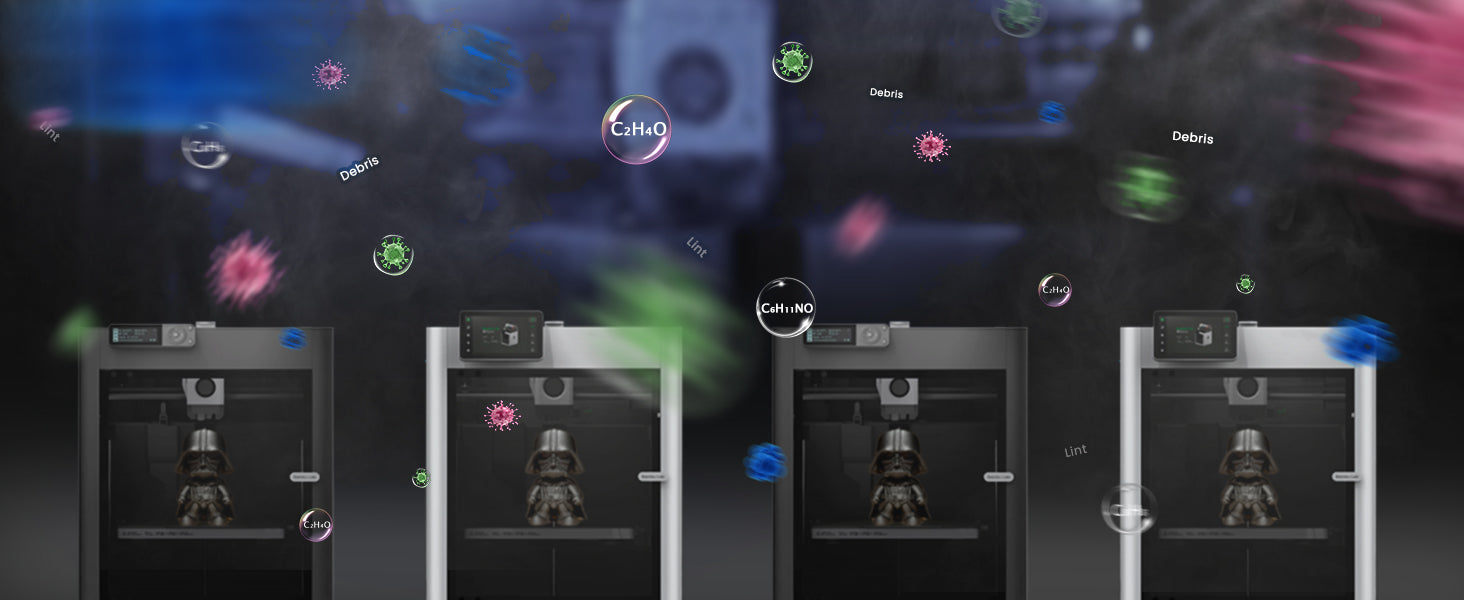
We’re not trying to scare anyone. It’s a simple fact: in an enclosed room/cover, particles and TVOC can accumulate over time.
Your options are straightforward: vent outdoors or filter the exhaust path. Our goal is to make your printing environment more controllable and more comfortable.
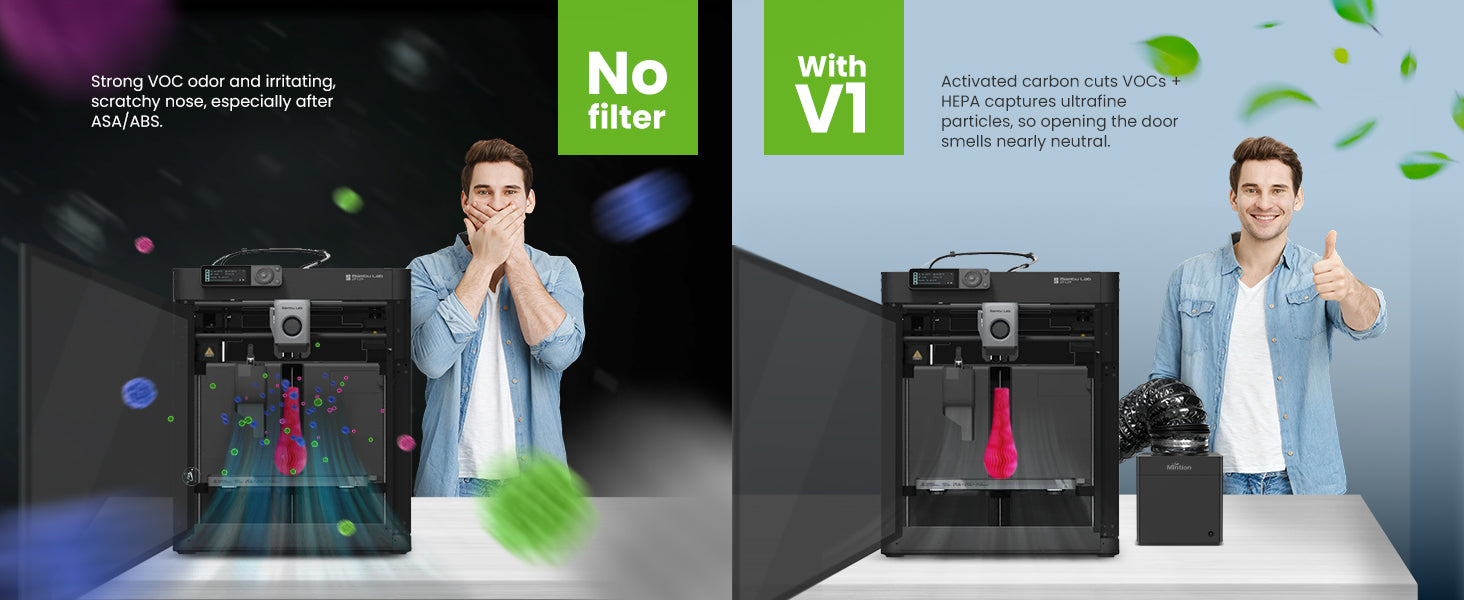
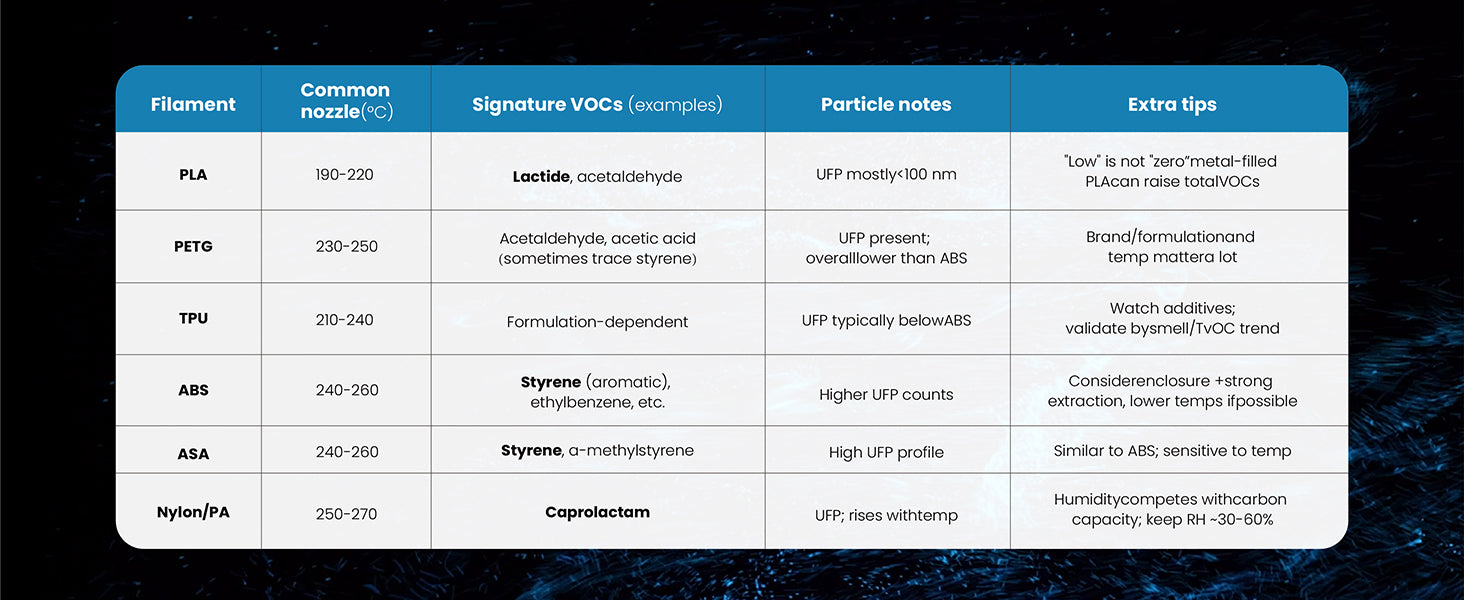
Different Filaments Release Different Things — Don’t Treat Everything as “Just Smell”
Particles (PM / UFP): Present with PLA/PETG/TPU
Gases (TVOC): Stronger with ABS/ASA/Nylon and other high-temp materials
Triple-Layer Filtration for Maximum Protection
Pre-Filter->HEPA H13 Filter->Activated Carbon Bed
Pre-filter
Captures larger particles and dust, helps with Larger debris, dust, lint
HEPA H13
Captures fine particles, helps with Fine particles from printing
Activated carbon
Adsorbs odors and VOC-related fumes, helps with ABS/ASA smell, printing odor
Testing Data, Not Vibes
Under comparable conditions (same printer, filament,), the curves show that with the filtration system on:
Particle and TVOC readings trend lower and more stable
After a post-print purge, the “door-open” odor spike is noticeably reduced
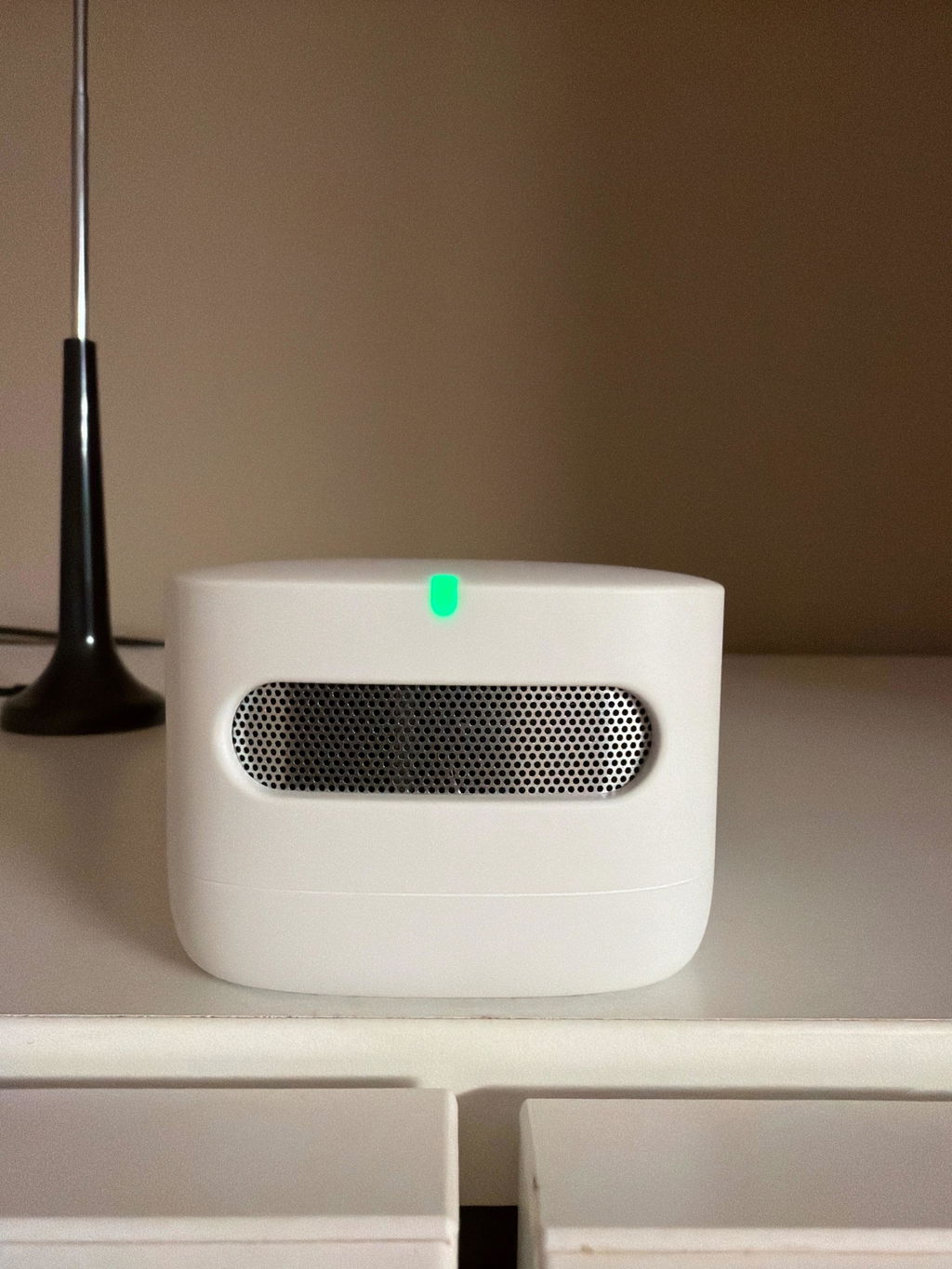
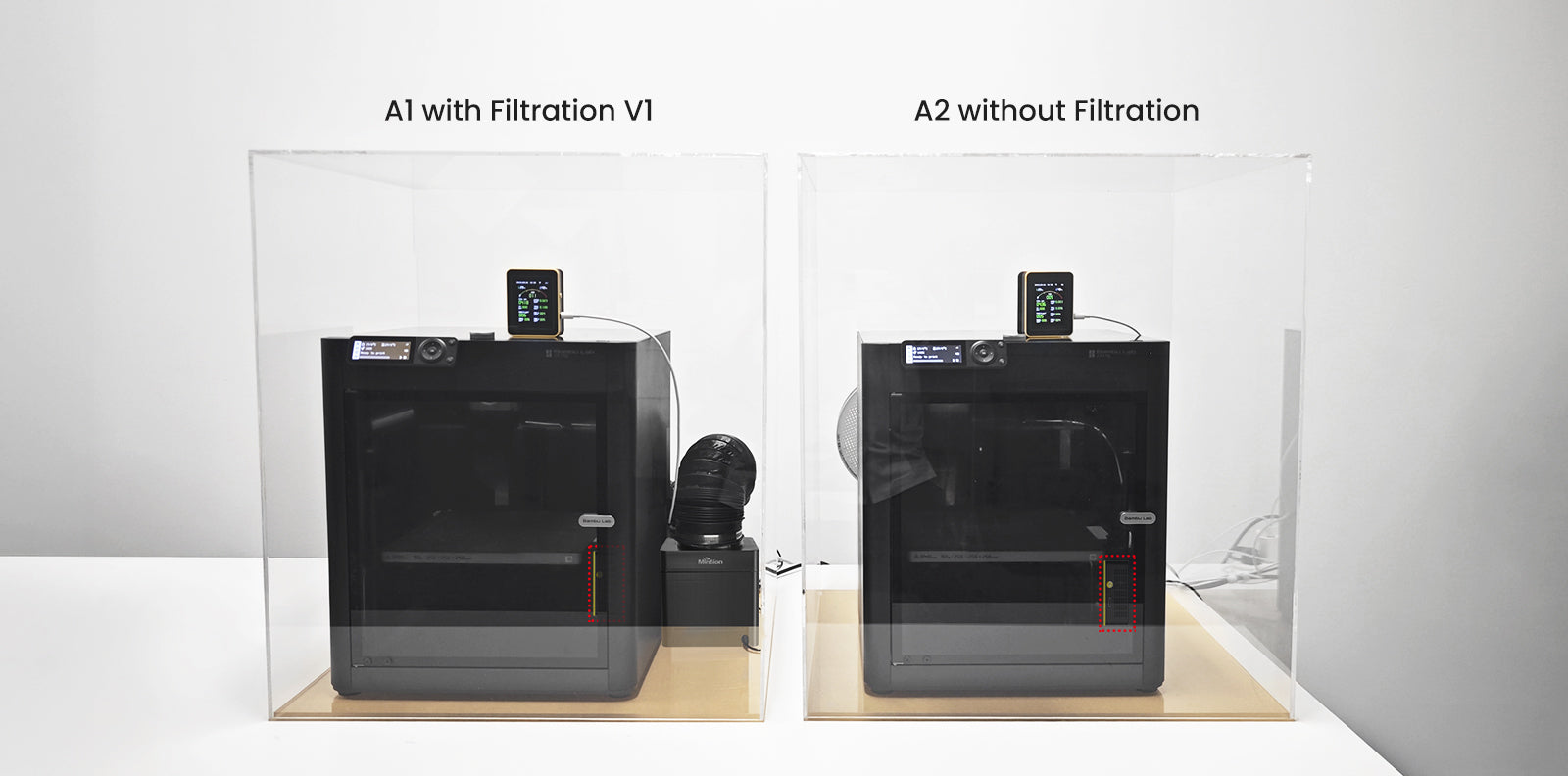
An MT15 air quality detector was placed inside each printer chamber to monitor particle levels (PM2.5/PM1.0) and VOCs. Additionally, another MT15 detector was positioned outside of each printer to measure particle levels (PM2.5/PM1.0) and VOCs inside the enclosure.
The same file was printed using PLA, PETG, ABS, and ASA filaments, with each print lasting 1–1.5 hours. Data was recorded every 5 minutes throughout the tests.
ABS Filament Testing
BLUE is P1S with the V1 Filtration System, RED is without a filtration system. IN is the air detector inside the printer's chamber, and OUT is the detector located outside the printer. Six data sheets (left and right arrows). 35-40% power of V1 during printing.


ASA Filament Testing
BLUE is P1S with the V1 Filtration System, RED is without a filtration system. IN is the air detector inside the printer's chamber, and OUT is the detector located outside the printer. Six data sheets (left and right arrows). 35-40% power of V1 during printing.


PLA Filament Testing
BLUE is P1S with the V1 Filtration System, RED is without a filtration system. IN is the air detector inside the printer's chamber, and OUT is the detector located outside the printer.Six data sheets (left and right arrows). 50% power of V1 during printing.


PETG Filament Testing
BLUE is P1S with the V1 Filtration System, RED is without a filtration system. IN is the air detector inside the printer's chamber, and OUT is the detector located outside the printer.Six data sheets (left and right arrows). 50% power of V1 during printing.


100mm Standard Ducting + Community Connector Library
Designed for Bambu Lab P1S/X1C, V1 uses standard 100mm inner-diameter tubing, making it compatible with most enclosed printers when a matching exhaust adapter is available. We curate downloadable connector files by printer model, including Bambu Lab 3D Printer H2S/H2D, P2S; Prusa enclosure; Creality 3D Printer, Flashforge 3D Printer... (database is continuously updated). Click this Compatible Connectors List for details.


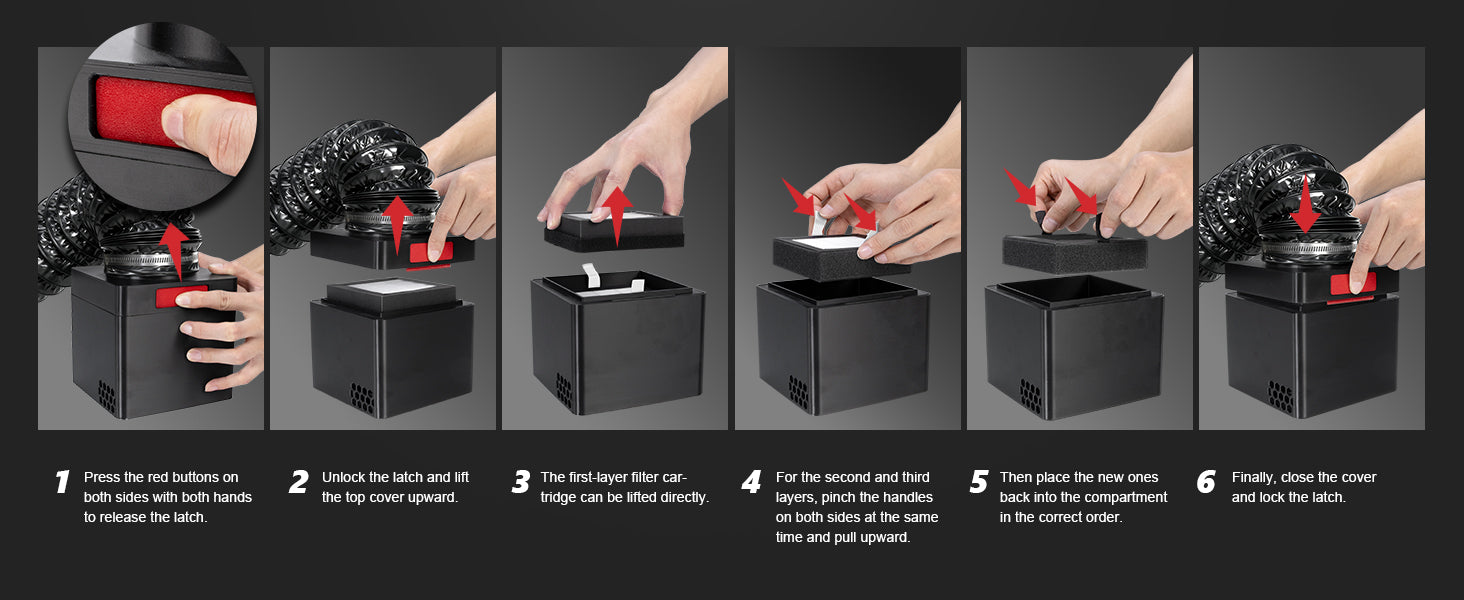
Easy To Exchange the Filters
Recommended Stacking & Replacement
- > General use (PLA/PETG and mixed filaments)
Stacking order: Pre-Filter → HEPA H13 → Activated Carbon
Typical replacement cadence: printing ~8 hours/day → ~3 months per set (actual life varies with material, enclosure cleanliness, and fan speed). Replace sooner if you notice airflow drop, odor breakthrough, or visible discoloration.
- > VOC-heavy use (ABS/ASA focus)
Alternative stacking for stronger odor control: HEPA H13 → Activated Carbon → Activated Carbon
(Replace the pre-filter with a second carbon stage for increased styrene adsorption. If your enclosure is dusty, keep the pre-filter and shorten the carbon change interval.)
Note: Due to the housing design, the pre-filter uses a half-width outer foam. When using HEPA H13 as the first stage, trim off half of the outer foam gasket on the HEPA’s intake/outside-facing edge to ensure proper fit and airflow sealing. Trim foam only—do not cut into the filter media.
Stay Health with Less Odor
Print ABS/ASA in the print farm or in-house. Health is also vital for your life.